
A MotorTrack user was already familiar with ChatGPT. After connecting MotorTrack with my help, she continued as before: by simply stating her requests in the conversation.
She could report one or more issues as she noticed them on her vehicle. The practical benefit was to avoid losing important details and to keep a clearer record for conversations with an automotive professional.
There was no new screen to learn and no menu to search through.
This isolated case cannot be generalized. It nevertheless shows a clear shift in difficulty: day-to-day use becomes natural, while the initial connection remains technical — but one-off.
The MotorTrack case
MotorTrack exposes an MCP (Model Context Protocol) server: a standardized access point that the conversational assistant can query to look up or change certain data, within the limits of the authorized tools.
From the user's side, this integration showed up as a connected app in ChatGPT. Technically, it was a custom MCP connector added through developer mode, since MotorTrack isn't listed in the public directory yet.
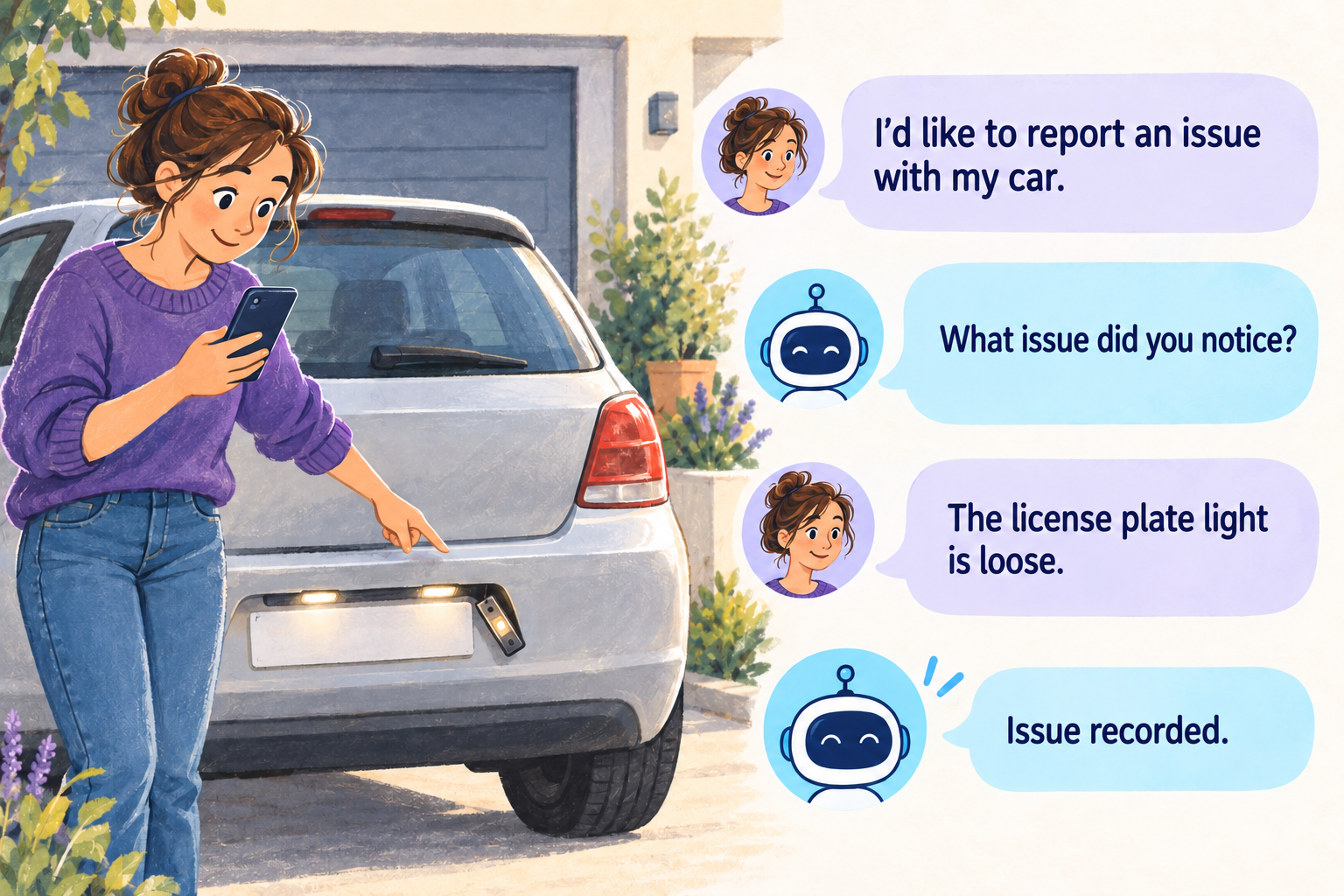
Setup required assistance: configuration, authorization, and a bit of technical vocabulary. This initial setup was the main constraint, but it only had to be completed once.
After that, using MotorTrack went back to what she already knew — a conversation. She did not have to learn another interface; she could keep doing what felt natural while recording vehicle issues as soon as she noticed them.
This observation remains isolated. It doesn't prove this mode of use is spreading — it documents one case where it worked, and where the nature of the friction clearly shifted.
App, connector, MCP: why the words blur the lines
The vocabulary doesn't make things easier, and it keeps shifting. A few reference points, as of now:
| Term | What it means |
|---|---|
| Integration | The neutral term used in this article for the whole setup. |
| Plugin | Since July 2026, the space where ChatGPT and Codex surface their capabilities. It can bundle one or more apps, skills, or app templates. |
| App | The integration that connects ChatGPT to an external service to look up information or carry out an action. |
| MCP connector | In some technical contexts, a custom app built on an MCP server. |
| MCP | The underlying technical protocol, when it actually powers the integration. |
| MCP server | The service that exposes the connected application's capabilities. |
| MCP tool | A specific operation offered to the assistant, such as looking up or changing data. |
These terms aren't interchangeable: a plugin can contain an app, but isn't necessarily one; an app can rely on MCP, but not every app depends on it. MotorTrack, here, is a custom app that does rely on an MCP server — the server it exposes is indeed an MCP server, and that protocol is what makes this app possible.
MCP was created by Anthropic in 2024. In late 2025, Anthropic transferred its governance to the Agentic AI Foundation, a dedicated fund under the Linux Foundation umbrella, co-founded with Block and OpenAI and backed by Google, Microsoft, AWS, Cloudflare, and Bloomberg — it's no longer a single vendor's proprietary technology (Anthropic announcement, Linux Foundation announcement).
What the user sees, what the developer builds
The user sees an app to activate.
The developer relies on a protocol and builds a server along with the tools it exposes.
That distance explains why usage, once the connection is made, feels so simple: the technical layer is no longer visible.
This level of use — an external tool called under the user's direct instruction — matches what I describe elsewhere as a tool-using AI assistant, as opposed to an agent that would decide the sequence of actions on its own.
What two studies show — and don't show
The MotorTrack case remains an isolated observation. Two recent studies on conversational interfaces help put it in context, without directly validating it — neither one covers MCP adoption by business users.
Voice CMS: updating content through conversation
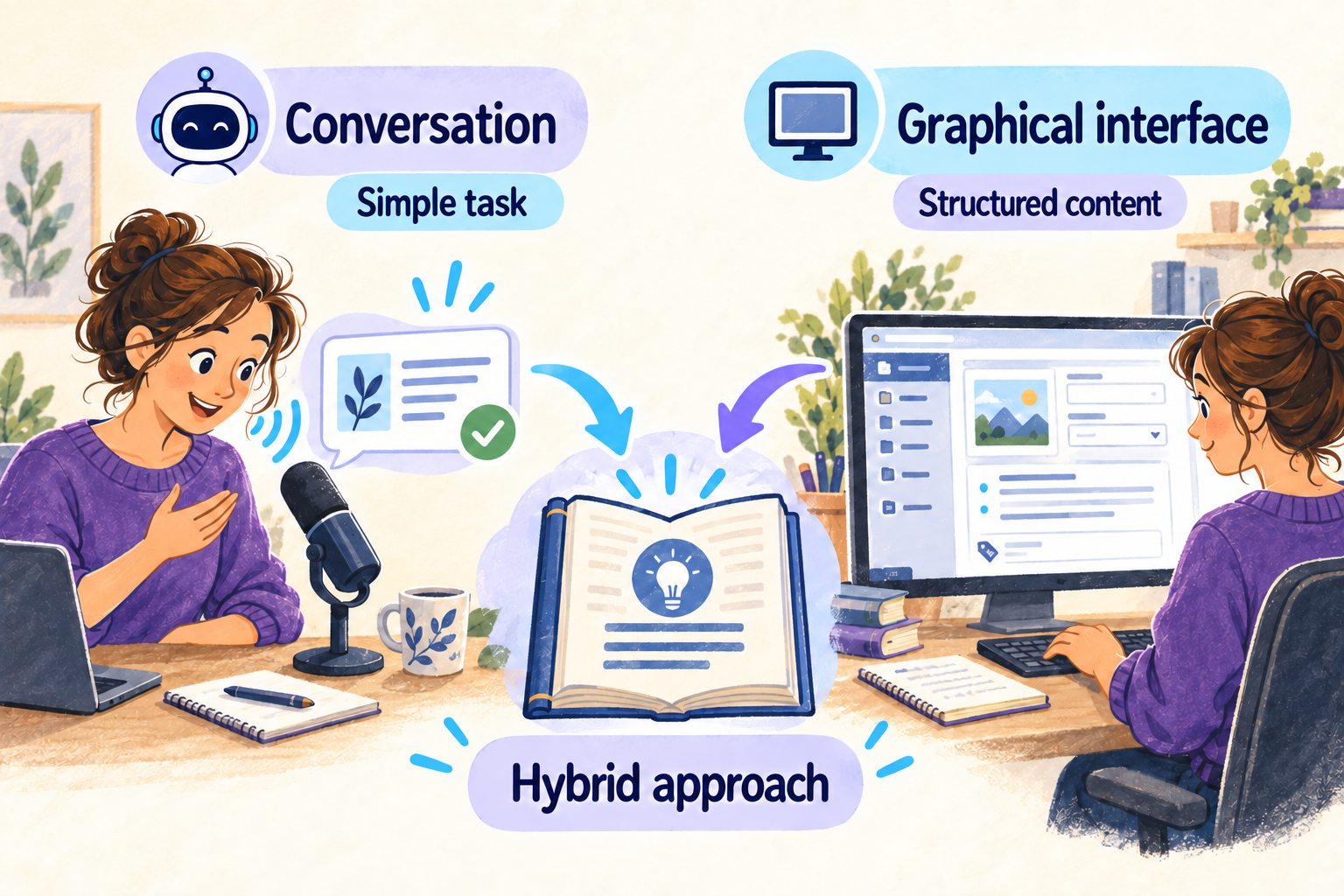
The Voice CMS: updating the knowledge base of a digital assistant through conversation study compares a conversational voice interface with a classic graphical CMS.
Result. The conversational interface is preferred for simple tasks, with comparable input quality even on complex content.
Limit. Its overall usability remains lower than the graphical interface's. The authors recommend a hybrid approach, not a replacement.
Industrial decisions: the advantage shrinks with complexity
The Neither Replacement nor Panacea: Comparing LLM-Based Conversational and Graphical Decision Support in Industrial Tasks study, conducted with 134 industrial decision-makers, compares the two forms of assistance.
Result. Conversation reduces mental load and saves time on simple tasks.
Limit. That advantage shrinks as task complexity grows. The conversational interface isn't preferred as the sole decision-support surface.
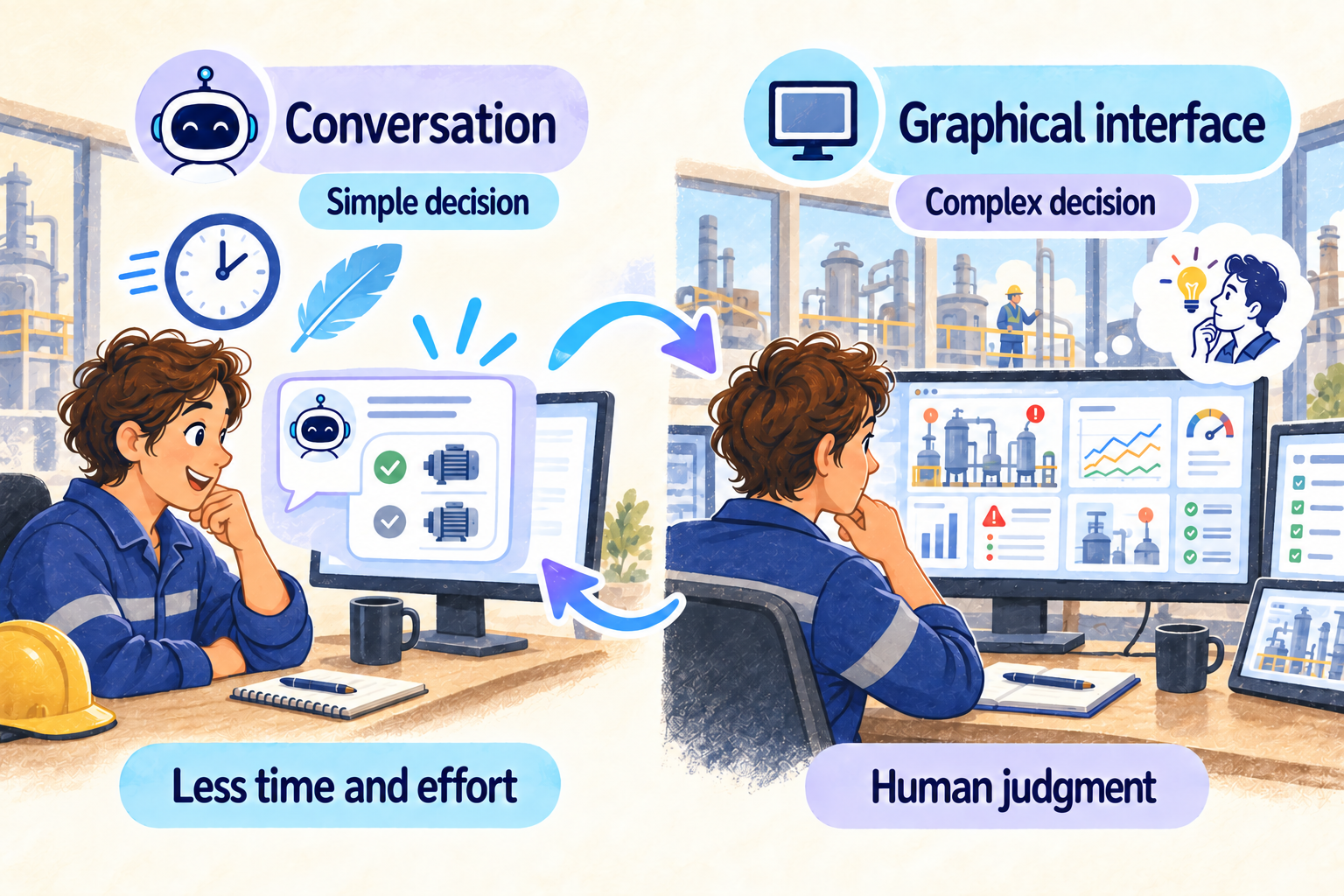
Both studies converge on the same point: conversation mainly helps on simple tasks, and coexists with the graphical interface rather than replacing it. That's complementarity, not validation of the MotorTrack case — which remains a field observation, not generalizable proof.
What this changes
Three things stand out from this case:
- A new entry point. Conversation provides access to the business application without requiring users to navigate its screens every time.
- A complementary interface. The graphical interface remains necessary for some uses. The choice is therefore not “conversation or screen”; it depends on the task.
- Friction has shifted. In MotorTrack's case, using ChatGPT felt natural once the connection was established. The main difficulty moved to an assisted initial setup: a significant constraint, but a one-time one.
The real design challenge is deciding which actions benefit from being available through conversation — and which are better kept on screen.
Personal account, based on MotorTrack's MCP server. The user mentioned stays anonymous.