
AI detection meets the reality of how we work
A few months ago, someone close to me recognized turns of phrase in one of my texts that they associated with artificial intelligence. I felt the need to justify the way I work.
More recently, the controversy surrounding writer Thélyson Orélien, accused following analyses made with an AI text detector, brought that question back into focus. Soon afterwards, posts about detection tools and provenance checks began appearing in my social feeds.
It resonates with my daily work. I use AI to write, organize and challenge ideas, produce code, and work on visual content. These uses differ in both scope and outcome. What are we actually detecting when we look for “AI” in a piece of content?
Inferring an origin from the text
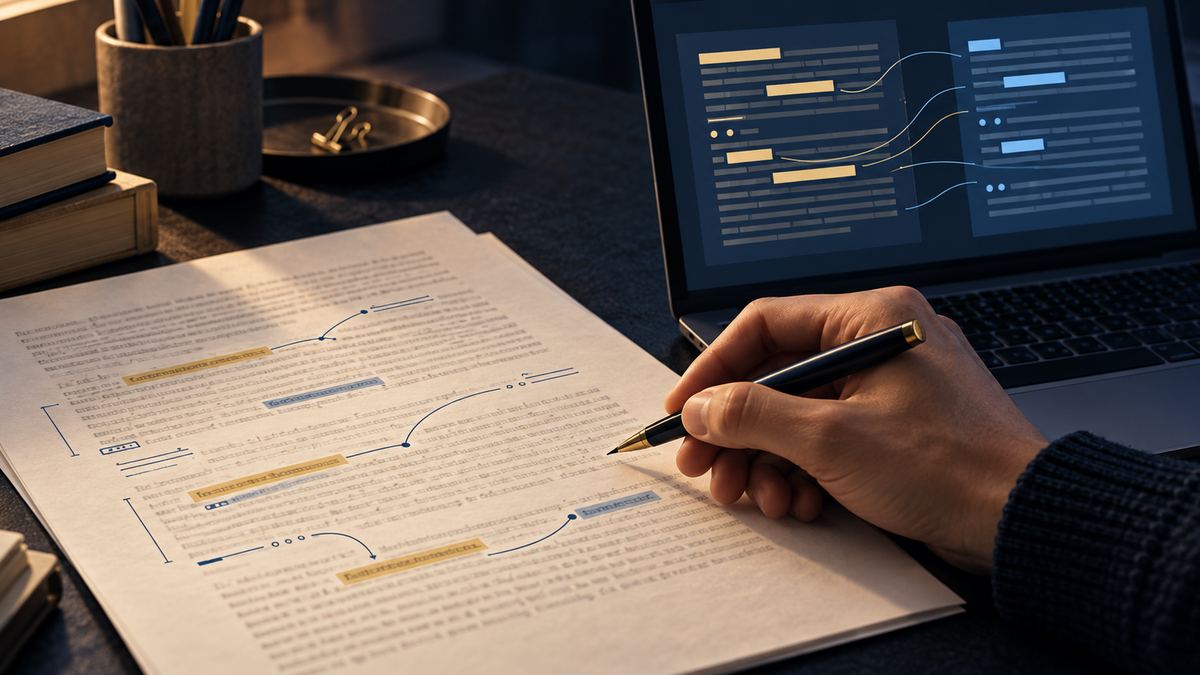
A tool such as Pangram analyzes features of a text: its grammar, punctuation, word choice and structure. It then estimates how closely the text resembles outputs from models it knows.
It does not find a mark left by ChatGPT or Claude. A high score indicates a statistical resemblance, not the share of the text written by AI. It is a clue to interpret, not sufficient proof of how the text was written.
Looking for a provenance trail
For images, video, audio and some documents, another approach is to preserve information about how a file was created and changed. Content Credentials, based on the C2PA standard, and certain watermarks are intended to help with this. For example, you can submit an image or audio file to OpenAI Verify to look for supported signals associated with OpenAI tools. Claude Check Files checks compatible files for Content Credentials associated with Claude. That checker does not analyze text.
The distinction matters: a text detector infers a likely origin from the content, while a provenance checker looks for a trace associated with a file. Finding no trace does not show that AI was never involved.

AI involvement does not tell the whole story
I could generate an entire image with AI, or remove one object from a photograph. AI is involved in both cases, but “AI-generated image” does not describe the same operation.
The same applies to text: a spelling correction, a rephrased sentence, help structuring an argument, or an AI-generated first draft that I rewrite extensively. One label conceals very different processes.
This article is an example. The question and observations are mine. AI is also involved in developing the text: I discuss ideas with it, then accept, revise or reject its suggestions. Calling the result simply “human” or “AI-generated” says little about what actually happened.
What detection can tell us
A resemblance score may draw attention to a text. A provenance signal may tell us something about a file's history. Both can be useful, provided we do not ask them to say more than they can: neither, on its own, describes the human contribution, the checks performed or the decisions behind publication.
I see a similar responsibility when I work with development agents. An agent may produce code; I still have to understand and check what I integrate. AI helped draft this article, but I chose the ideas, revised the text and decided what I would put my name to.
The useful question is not only “Was AI involved?” It is also “What did it do, what was checked, and who stands behind the result?”